




















An abridged version of this story appeared in Issue 6 of The Ahlahasa.
When most people think of the Ku Klux Klan (KKK), they think of white-hooded horse riders burning crosses, terrorizing Black neighbors at night and holding picnics at the hundreds of lynchings that plagued the South throughout the 19th and 20th centuries. They think of pale ghosts, merely faint memories of the past, best to be long forgotten. But what people don’t think of are the crosses that were burned in Minnesota, the 51 different chapters of the Klan that tormented Minnesota’s people of color and immigrant residents in the 1920s. The Klan was not confined to the Deep South, but rather it was found everywhere across the United States, including Minnesota and Freeborn County. Most people have forgotten that the first ever public event the Klan held in Minnesota was held in Albert Lea, at the exact same fairgrounds that are crowded with numerous fair rides and bustling crowds every summer. This dark chapter of Freeborn County’s and Minnesota’s past has been long forgotten by the general public, which unfortunately has led to similar rhetoric that the Klan used in the 1920s to be used 100 years later. By taking a look back at this uncomfortable, but necessary, piece of history will help people in the modern day look more critically at the hateful speech that has permeated our society.
The KKK was not one singular fixed group throughout history but instead went through different manifestations. The first version of the Klan was the group started in 1866 by Nathan Bedford Forrest, a former Confederate general. The KKK was created as a reaction towards the South’s loss of the Civil War and the Reconstruction’s new policies that aimed to integrate formerly enslaved people into society as a whole. The KKK was composed of former slave owners and white racists that sought to enforce white supremacy in the South by terrorizing Black civilians. The KKK wore white hoods to obscure their faces and inflicted fear through lynchings, kidnappings, assault, nighttime raids, burning houses and burning crosses. The first version of the KKK was disbanded by Forrest in 1869 after the U.S. Supreme Court passed a few acts that broke up white supremacist groups.
Unfortunately, this was not the end of the Klan. In 1915, a film called “The Birth of a Nation”, which glorified the KKK, became popular. This film inspired the preacher William Joseph Simmons to revive the Klan. This new version retained the same esoteric rituals and extreme racism that the previous Klan had, while also including patriotism and nationalism as main tenets in their beliefs. The new Klan also held anti-Catholicism, antisemitism, anti-immigration, anti-birth control and anti-evolutionary stances. In order to retain a positive image among the public, the Klan attempted to frame itself as a family-friendly organization that was for patriotic American citizens. They bolstered their public image by donating to Protestant churches and various community organizations. But the Klan did not just pop up out of nowhere; it arose from the simmering tensions that lingered from the recent World War. The economic struggles after the war left many Americans in need of a scapegoat to blame all their troubles on, and the wave of immigration from Eastern Europe and the migration of African-Americans from the segregated South all provided easy targets to blame their problems on. In Minnesota in the 1920s, there was only a very small percentage of Black people, only around 1% of the entire Minnesota population, so the KKK instead focused more on demonizing immigrants, Jews and Catholics. German immigrants were especially hated due to America fighting against Germany in the first World War, so the Klan used intimidation tactics to prevent immigrants from speaking their native languages. These tactics included burning crosses to instill fear within the populace, and they threatened anti-Klan people and ex-Klan members by framing and blackmailing them, causing the victims to lose popularity within the community. The severity of the threats levied against people led to death by suicide in a few instances. Klan sympathizers also published lists of immigrants they deemed as “traitors” in the newspapers, including immigrants that gave up their naturalization papers in order to avoid the World War draft. The Klan also targeted Catholics, since they believed that their allegiance to the pope in Rome was a foreign influence, which prevented Catholics from being “true” Americans. They claimed that Catholics wanted to exterminate all Protestants and that Catholics were behind all previous assassinations of American presidents. Because of the already rampant anti-immigration sentiment in American society at the time, the KKK was able to capitalize upon it and utilize this fear to increase their membership.
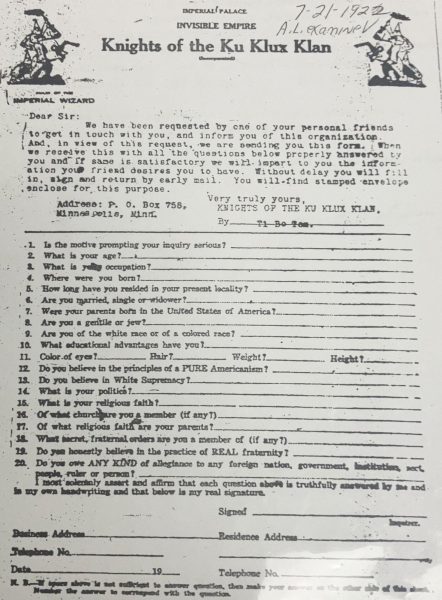
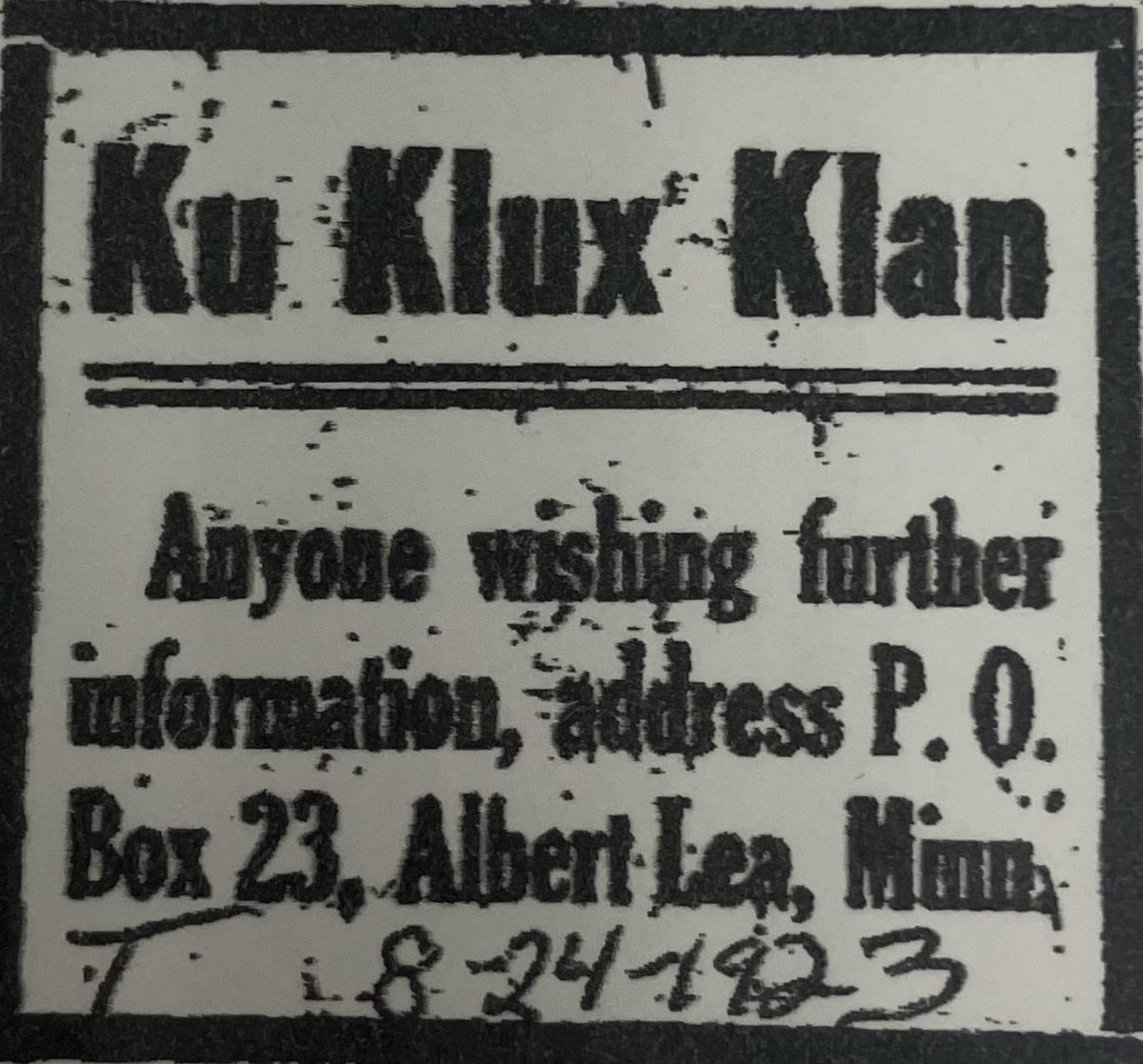
In order to become a member of the KKK in the 1920s, you had to fit all of their criteria. This included being white, Protestant, non-Jewish, and not being an immigrant or the child of immigrants. The KKK’s rule about immigration initially gave them some problems when trying to expand in Minnesota, since around 70% of Minnesota residents had parents that weren’t born in the United States. The KKK attempted to get around this by having “naturalization ceremonies,” which allowed for children of immigrants to be “naturalized” in the eyes of the KKK and therefore permitted to become members of their organization. Naturalization ceremonies were only performed on children of immigrants that were themselves born inside the United States. Anyone who fit these criteria were able to become members of the KKK, including women and children. The KKK increased their membership by advertisements in newspapers, public speeches, passing out fliers and pamphlets to households, and the circulation of the Minnesota KKK’s newspaper, “The Call of the North” (later renamed to “The Minnesota Fiery Cross”). At its height, the KKK had tens of thousands of members in Minnesota. Many of these members were World War 1 veterans and police officers: for example, 50% of the KKK’s Duluth chapter were veterans and American Legion members.
Some of the first Klan activity in Minnesota happened right after the Duluth lynchings of 1920. On June 15, 1920, a white mob broke into the Duluth jail and took three Black men, whom they hung from lampposts out in the streets, while the Duluth police stood back and watched. The men were accused of raping a white woman, which was a common accusation used by racists against Black men in order to have an excuse to lynch and murder them. Although there was no evidence for this accusation, which meant that the mob murdered three innocent men, only three people were later convicted for participation in the lynchings, and they were given prison sentences of 15 months each. Less than a year later, a local Duluth Klan chapter popped up, being one of the first known instances of Klan activity in Minnesota. The Klan soon spread across the state, having a presence in over half of the state’s counties and towns, with 51 different chapters, including ones in Duluth, Rochester, the Twin Cities, Owatonna, Red Wing, Austin and Albert Lea. Unlike the KKK in the South, the Minnesotan KKK focused less on violence. One of the main reasons for this was due to the 1921 anti-lynching bill by Minnesota’s congress in response to the Duluth lynchings, which imposed heavy punishment on anyone found to have participated in lynchings. Instead, the Minnesotan KKK focused more on intimidation and threats. One example of this happened in 1922, where a KKK-led mob of over 500 people burned crosses on Charles Chapman’s lawn, who was a Black man living in the Twin Cities suburbs. Another law attempting to combat the KKK in Minnesota was passed in 1923, which banned the use of masks and hoods in public, but unfortunately this law seemed to not be well-enforced and did not succeed in dampening the KKK’s presence.
The first known Klan activity in Albert Lea happened on April 20, 1923. Fourteen crosses were placed at various areas around town, including Fountain Street, Broadway and the Downtown area, Katherine Island and near the YMCA. The crosses were burned in the evening, and a Klan meeting was held in an auditorium on Broadway the next night with the aim to recruit new members. The general attitude towards the Klan in Albert Lea was not of disapproval but rather of curiosity and interest in their events. Besides the singular instance of someone shoving the burning cross on Katherine Island into the lake, there was little resistance towards the KKK, and this attitude would unfortunately be the predominant one in Freeborn County during the 1920s. In the span of four years, there were at least 10 different instances of public cross burnings in the county and at least 20 different public events, although there were presumably many more meetings that were private.
Soon after the first cross burnings in Albert Lea, there were also two crosses burned in Glenville, which were probably set up by Albert Lea Klan members, according to eyewitness accounts. On June 29, 1923, the editor of the Minnesota KKK’s newspaper, “The Call of the North,” came to Albert Lea and spoke to a crowd of 2,000 people in Morin Park. His pen name was “Twilight Orn,” but his actual name was Peter J. Sletterdahl, a former schoolteacher and a KKK state-level organizer of the Dakotas. Sletterdahl was the main organizer of Albert Lea’s public events and was oftentimes a speaker at these events. The first ever public event put on by the KKK in Minnesota was in Albert Lea, on August 31, 1923. Before the event, a group of KKK members paraded through Albert Lea’s business district. The event was held at the Freeborn County fairgrounds, and an opening prayer was given by Dr. Harper, who was a national lecturer for the KKK and was present at many Freeborn County Klan events for the next few years. The main speech was given by Sletterdahl, whose aim was to recruit more members and to preach white supremacy and nationalism. After his speech, a naturalization and initiation ceremony were held for two new members. A group of fully hooded Klan members on horses surrounded the stage where the ceremonies were held, and after the ceremonies three crosses were burned, and fireworks were set off. After the event, the Klan held another parade that went down Broadway.
For the next four years, the KKK held a firm presence within Freeborn County. Crosses were burned on Broadway, Central Park, and even once at the fairgrounds on July 4. Sletterdahl and Dr. Harper continued to hold many meetings to try and recruit more members, either holding them in auditoriums or outdoors. Thousands of people attended the larger events, both in Albert Lea and in nearby towns. Albert Lea’s KKK chapter attended events in other towns, including Austin, Fairmont and Owatonna. The 1924 event in Owatonna had an estimated 15,000 people in attendance. Most of the public didn’t see these events as the hateful, racist occurrences that they were but were instead treated as fun spectacles that the entire family could attend. The local newspapers described the first event at the fairgrounds as “one of the most spectacular scenes ever witnessed in this part of the state,” and also wrote a praising description of an Austin event, saying “the scene was majestic in its beautiful blending of colors with the white robed figures heading the column.”
The Klan not only held parades, events and speeches, but they also participated in weddings, funerals, and even movie theater nights. In 1925, there was a Klan-themed wedding held in Albert Lea. Everyone that attended wore KKK regalia, and a burning cross provided lighting for the venue. In 1924, there was a Klan funeral of a boy that died in a car accident in Glenville. The KKK administered burial rites, and a floral fiery cross decorated the grave. Around that same time, the KKK rented out the Rivoli movie theater and showed a pro-Klan movie titled “The Traitor Within”. The Rivoli management had to issue a statement in the newspaper claiming that they took no part in choosing the movie and were merely renting out the space, which means that there was at least a small amount of pushback from the community.
The Klan also took it upon themselves to enforce law and order. The Klan was adamantly against alcohol, and since this was the time of Prohibition (when alcohol was banned in the U.S.), they sometimes threatened people who were illegally drinking. In 1924, thirty cars full of Klansmen drove to a dance hall in Myrtle, burned a cross outside the hall, and went inside and warned the dancers that drinking and gambling were against the law and that they were keeping an eye on everyone in the county. The Klan balanced their threats with donations to community groups in order to maintain their reputation. In 1926, a group of Klan members entered the Cavalry Baptist Church during a sermon and donated more than 100 dollars in exchange for being able to give a short speech after the service.
At its height in the 1920s, the KKK had a total of five million members nationwide. Even though the Klan made an effort to appear as a family-friendly, patriotic organization, it was still responsible for more than 400 lynchings of Black people during the decade. The Klan became even more associated with violence in the mainstream opinion after the Grand Dragon (state-level organizer) of Indiana, David Stephenson, was convicted of the rape and murder of a state government employee. Because of this, the Klan’s public image became associated more with brutality and violence, which led to a drastic decrease in its membership to just 30,000 in 1930. The last reported Klan activity in Freeborn County was on August 14, 1927, where the KKK had an event at the fairgrounds and a parade down Bridge Street later in the evening. This is the last known reported Klan activity in the county, although there may have been several more private meetings in 1927. But it appears that the Klan in Freeborn slowly died out and left not with a bang, but with a whisper.
Because the Klan faded into obscurity in Minnesota, people often don’t know that the KKK was in the state, let alone in Freeborn County. Relics from the Klan were often destroyed by embarrassed family members in the following decades, leading to local county museums having only a few artifacts left in their possession. The history of the KKK in Minnesota should be openly discussed to remind us of the dangers of letting the past be buried. How can we learn from the past if we purposefully forget it? Just because the KKK itself is but a shadow of what it once was doesn’t mean that there still isn’t work to be done; it doesn’t mean that racism and bigotry have disappeared. Nowadays, racism isn’t hidden behind a hood; it is hidden behind a screen. People casually say slurs on social media and spread hateful lies about people of color and immigrants. More than a thousand people are murdered by law enforcement every year, and a large percentage of these victims are people of color. Many people are still living in fear every day, and it should be the duty of every community member to protect the more vulnerable and to ensure their safety. We must learn from this dark chapter of Minnesota’s and Freeborn County’s history so that we can make sure that the horrors of the past will not be repeated.
Thank you to the History Center of Freeborn County for providing most of the information about Freeborn County and for the use of their facilities. Other sources used in this article are MPR News, the Minnesota Historical Society, EBSCO, and the book “The Ku Klux Klan in Minnesota” by Elizabeth Dorsey Hatle.