













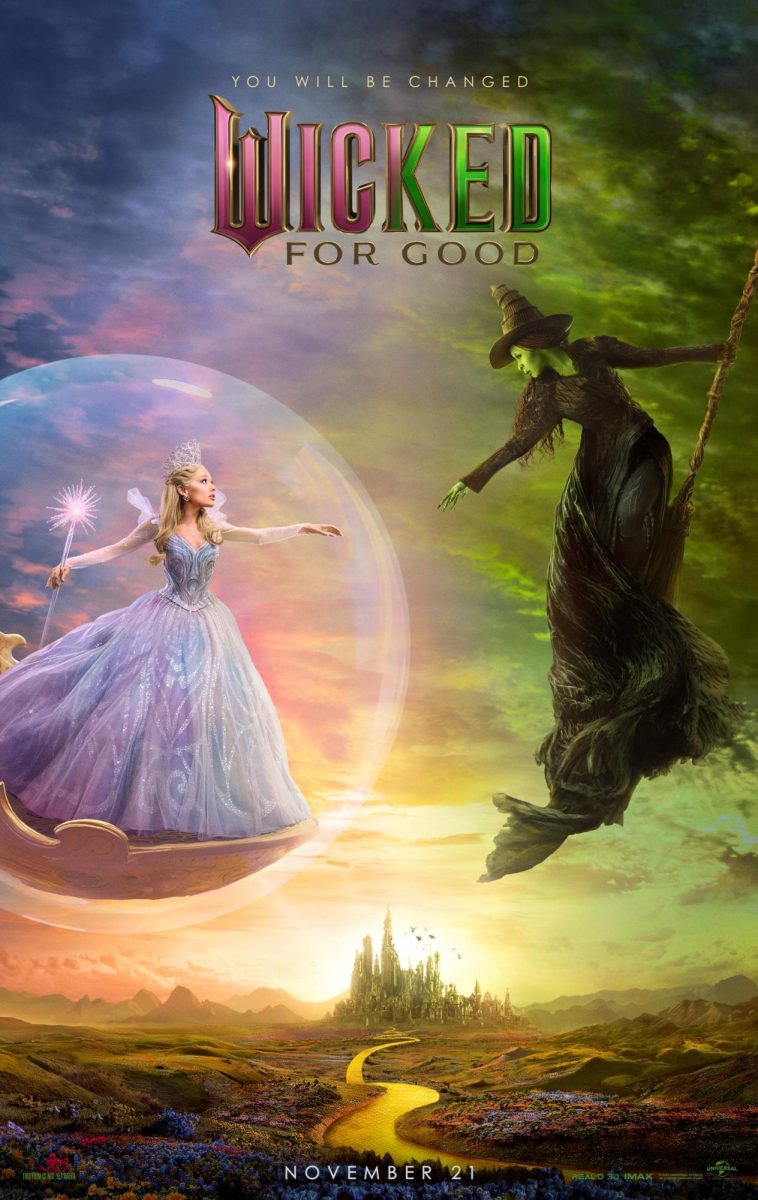
“Wicked” has been around since 1995 and was written by Gregory Mcguire. It tells the tragic story of the Wicked Witch of the West, Elphaba. Recently, the story is back in the headlines due to the release of two movies: “Wicked” and “Wicked: For Good”. The “Wizard of Oz” spin-off first started out as a book by Maguire, and then was adapted into a Broadway musical in 2003 by Winnie Holzman (script) and Stephen Schwartz (music and lyrics). The current adaptation is from Broadway to the big screen in two movies released in November of 2024 and 2025.
The politics of Oz are the storyline in both the musical and movies. Even though it’s packed into the plot, some viewers focus on the songs and the romance. They are dazzled by the spectacle rather than the substance. Which only makes the political message stronger.
[Spoilers for the movies ahead.]
The plot follows Elphaba Thorpp, played by Cynthia Erivo, as she attends Shiz University. We see people state at her green skin and gasp in horror until Galinda (known as Glinda later on), played by Ariana Grande, takes her in and makes her “popular”. Galinda sings about the performance of social acceptance and the power of creating a narrative about oneself.
Not much later, Elphaba realizes that there is something wrong in Oz. The Land of Oz is largely fascist, mainly due to the works of the Wizard. We see him create propaganda and push views that lead to him being in higher power. The people believe what he says because in their eyes why would he lie to them? The Wizard (Jeff Goldblum) uses scapegoats to create fear of a common enemy which in this case is literal goats. According to the Wizard, the animals are bad. They are the cause of every harmful and terrible thing that happens in Oz. He pushes his totalitarian agenda onto the Land of Oz while he oppresses and dehumanizes the animals. Elphaba knows what it is like to be dehumanized and oppressed, and is able to empathize with the animals.
When she’s invited to go see the Wizard, she asks him to help the animals and discovers that he’s the one behind it. She refuses to join the Wizard and is labeled the Wicked Witch of the West. On the other hand, Glinda offers compliance to the Wizard and is named “Glinda The Good”. The government of Oz is run by two untrustworthy people. The one that pulls strings but isn’t directly seen as in charge is Madam Morrible (Michelle Yeoh). While everyone thinks the Wizard is in charge, they both know that he doesn’t hold any true magic. He isn’t actually wonderful. And he lies to the people of Oz.
In “Wicked: For Good”, Dorothy Gale (Bethany Weaver) enters into the story. This is the backstory and the story that we see in the 1939 film “The Wizard of Oz”. The citizens are led to believe that the Wizard is this all-knowing, magical and wonderful man when he’s a con man. Morrible and the Wizard continuously feed into this narrative, making the belief stronger despite the truth. Not only do they hide that he’s a con artist, they hide that he is the evil in Oz. The song “Wonderful” follows the Wizard and Glinda trying to get Elphaba to join their side and their cause. He basically admits to being a fraud in this song, but he would never admit it to the citizens of Oz. They don’t really know where he comes from and think he is just a normal guy that happened to pop into Oz and build a town of emerald.
The most prominent propaganda we see within the movies are posters of Elphaba warning to “Beware the Wicked Witch”. We mainly see these while they are being torn down during the “No One Mourns the Wicked” sequence. Different posters are seen in this scene throughout Munchkinland. They paint her as a wicked witch, putting emphasis on her appearance, to make her seem untrustworthy and evil to the people of Oz. She rejected the Wizard and they didn’t want her to out them as con artists, so they paint her as the villain. They twist things she does into being something bad. We see this showcased at the end of the “Thank Goodness/Couldn’t Be Happier” songs. While Elphaba wrote “Our Wizard Lies” in the sky, Madam Morrible uses her power of weather control to change the clouds into saying “Oz Dies”. This is seen as a threat and causes panic which feeds into the agenda that they are pushing against Elphaba and the animals. They are easy to blame. They are bad. They are blamed for all the troubles in Oz.
Elphaba is not only a political scapegoat, but also the scapegoat in her family. The family that was supposed to love her, practically disowned her. Elphaba was an affair baby, the proof of that being her green skin. She was disliked and shunned due to her skin, being deemed as different and a misfortune on the family. She is blamed for the dysfunction within her family and any problems they have. She was born green. Due to her being different people treat her as less than. The more people dislike her, the easier it is to make her a scapegoat. The dislike, whether it be for a good reason or not, allows everyone to believe the worst about her. Elphaba is what people deem evil, so anything bad goes onto her. She could blame her for any evil, and the people of Oz would believe it. In the eyes of the Wizard, it makes her the perfect scapegoat. This didn’t make her a bad person. She stayed true to what she believed in and stayed strong. When she saw animals being shunned and taken away, she stood up for what she believed to be right and tried to help.
It didn’t always work out the way she wanted or expected it to. For example, she rescued the lion, known as the Cowardly Lion (Colman Domingo), when it was a caged cub by releasing it into the wild. Later, it was twisted in the story by the lion that she caused him pain and suffering by leaving him alone in the woods and unable to care for himself so he became cowardly. She did what she thought was best. She uses her magic to try to help but it often has unintended consequences for the people and animals she is trying to help. Elphaba recognizes this herself in “No Good Deed”. She knows that all of her deeds, good or bad, are seen as wicked by the people around her. She is painted as the villain simply for not believing the government and knowing the truth about the Wizard.
Glinda is everything that Elphaba is not. They present her as good because she conforms. She is willing to be ignorant and not speak about her beliefs. She likes being popular and adored. She is the opposite of Elphaba which just makes her better in everyone’s eyes. In a way she is also a con artist. Glinda is said to be the “good witch” and everyone believes she has magic, even though she doesn’t have any magical powers. She is compliant throughout her life, bringing her to the Emerald City and giving her influence on Oz. She helps push the propaganda against her friend. Privately she may be conflicted about her role but publicly she does what is asked of her by Madam Morrible and the Wizard. Glinda is a good example of someone turning into a puppet of the government.
There are a few smaller scenes that fold into a political storyline too.The poppy scene in the first movie involves Elphaba using sleeping poppies around a classroom which puts her classmates to sleep. This allows her to rescue the lion cub. This scene is saying the masses are asleep. Only the people that are staying silent and choosing ignorance are going to fall asleep. If they don’t wake up and care about the animals, it will become disastrous for everyone. Later in the second movie we see that Munchkinland was put on lockdown. The Munchkinlanders were not allowed to leave their land and travel unless the mayor specifically gave them permission. This forced many families to stay.
The Wicked movies have intense political themes. They relate to the real world. They show us that people need to wake up and see what’s happening. That it can start to affect everyone. It shows that ignorance isn’t forever. It’s a fictional story with very real messages. A story like this should change people’s minds for the good.
