


















“The Long Walk” by Stephen King has been haunting generations. A gory dystopian story that gives you an adrenaline rush as if you were in the Long Walk yourself. The most terrifying part of it is that it doesn’t feel too far off from reality. Though this covers both the movie and the book, our main focus in this article is the movie and its ending so spoiler warning.
The original novel, published in 1979, was an angry response to the Vietnam war, especially the draft. Though it was originally written in the late 60’s, when the draft was going on. It was published under King’s pseudonym Richard Bachman. He had this pseudonym so he could publish more than one book per year.
The plot follows a group of boys, who are mostly in their teens, getting selected to go on this walk where only one makes it out alive. They are selected via a lottery system. There is a “back out” date, but many don’t back out of it, choosing to stay in it to be “honorable”. One hundred boys go into this walk, knowing they might not make it out. Each boy is assigned a different number and a dog tag corresponding with that number. They are walking for an unclear “prize”. They don’t know what’s at the finish line, but they know that they and their friends might not make it.
The book focuses on many characters but there are only a few that we focus on more, Ray Garraty (Number 47) and Peter McVries (Number 61). Of course there are different characters that are recurring, but these characters are the main focus. These boys have to walk at a constant speed of 4 miles per hour, if they fall behind, they get a warning. The way the warning system works is you only get three warnings before you get your ticket (death), but the warnings go away within a few hours if you do not end up getting your so-called ticket. For example, if you get one warning, it will go away within an hour if you do not get another warning within that hour. If you get all three warnings but manage to not get your ticket, you have three hours of not getting a warning before they go away. Stepping off of the pavement is an immediate ticket.
They get unlimited canteens of water, but only get a few tubes a day of “food”, which is a concentrate. They don’t get to rest their legs or sleep.They walk through different towns, being filmed and having crowds cheering with signs. These crowds treat it like entertainment, even cheering louder when they witness somebody getting shot. The book has descriptions of the gore and detailing to show how young these boys truly were. King doesn’t shy away from this gore due to him wanting the audience to see how bad and devastating the long walk truly is.
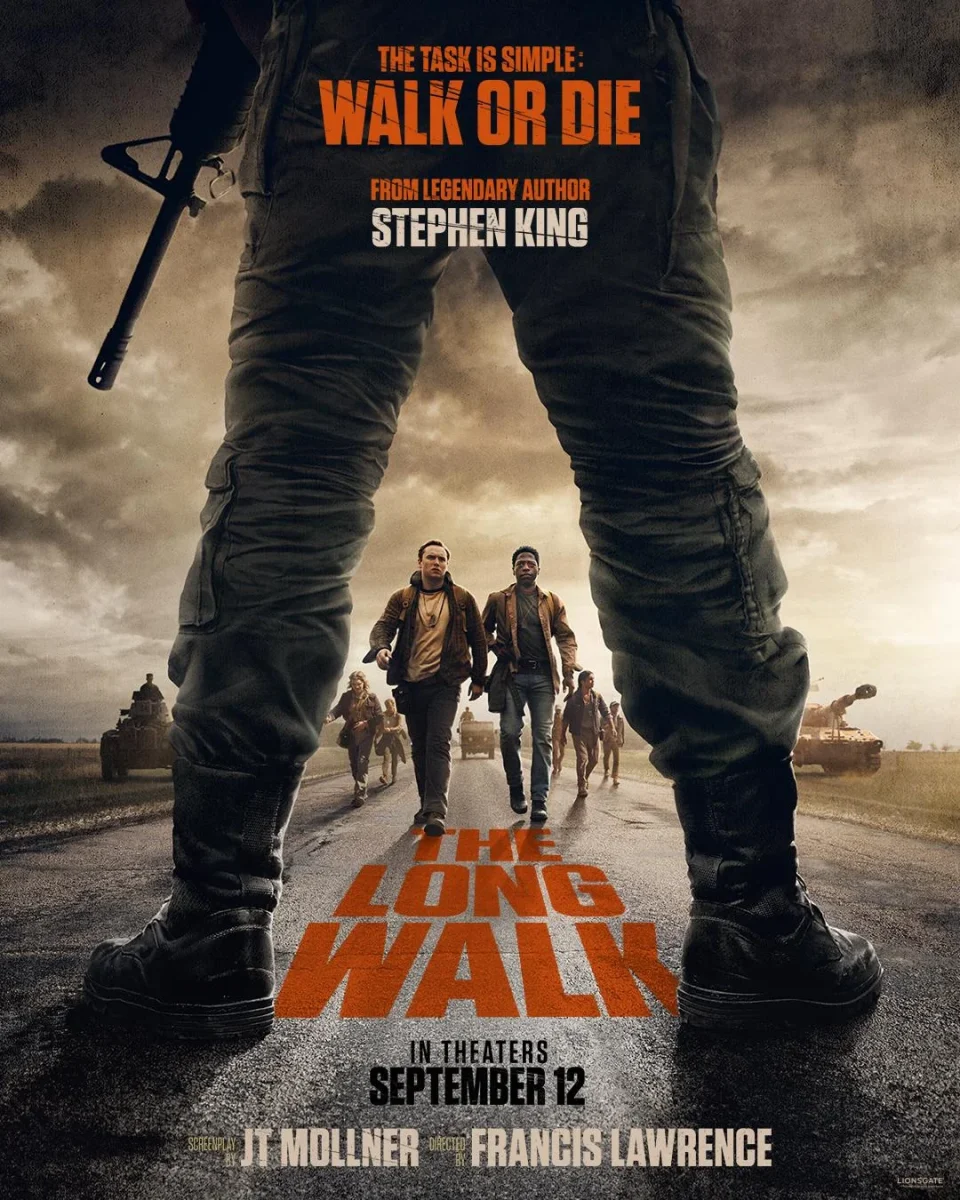
Now, about 40 years later, we get to see “The Long Walk” hit the big screen. With amazing actors like Cooper Hoffman (Ray Garraty, #47), David Jonsson (Peter McVries, #23) and Mark Hamill (The Major). The movie follows the same plot as the book with only minor changes to make the watch more interesting and easier. We get high intensity moments that leave you on the edge of your seat, wondering who is going down next or what will happen.
Many of the characters get warnings, and it makes you anxious to see if they will get all three. We see many different things happen, like someone having a seizure, people getting cramps and charley horses, but they are forced to keep walking and are shown no mercy, no matter what. The audience gets to see the characters establish themselves and fall more and more into a dark place. We see close friendships start then end with a gnarly finish. As we grow more and more attached to these characters, the more these deaths shock and hurt us, even though we knew it was coming. This movie doesn’t hold back on the gore and disturbance of the death march. The more people die, the more we see our main characters start to grow desensitized, sometimes even to their own friend dying, but that isn’t true for some. These boys struggle with the death of their friends, but they have to keep walking to survive.
Though most of the differences from book to movie feel minor, they do change the storyline. In the movie, it isn’t really said if the Major follows them around or not, you can feel his presence but you don’t really see him. While in the book, it’s said that he goes off and doesn’t follow the walk, only popping up whenever he wishes. Though the reality in the book could also be true in the movie, it isn’t really mentioned. Minor details are changed like the amount of people. While there are 100 men in the book, they narrow it down to 50, one for each state, in the movie. There’s even some things that don’t even make it to the movie. In the movie, we are rarely even introduced to Percy as a character. Although it is somewhat the same in the book, there’s a scene where Percy’s mother is running through the walkers looking for him. We learn that any outsiders interfering with the walkers in any way, even offering aid or something as simple as soda, is against the rules. Though bystanders are able to speak with them, they cannot help. They just have to watch these walkers in their state.
Even things about certain characters have been changed around. The overall change is the age of the characters. While in the book, we mostly see younger characters, like 16 year olds, in the movie they seem to be a bit older. Peter McVries himself is nearly a totally different guy. In the movie, he’s a kind and loving guy. The scar around his eye is due to a fight he got into after becoming an orphan. While in the book he’s not so sweet of a guy. He gets angry and even sometimes pokes at his friends in mean ways. His scar is due to getting slashed in the face by his, now ex, girlfriend after trying to force himself onto her. The movie Peter compared to book Peter are polar opposites of each other. Along with Stebbins. Movie Stebbins is a large fit man who is deemed normal but also seems like he has an unfair advantage. While book Stebbins is lanky and is described to be almost alien. One of the biggest differences is the winner of the walk, along with the final two remaining. The final two remaining in the book are Stebbins and Garraty, while in the movie it’s Garraty and McVries. The winners are even different. In the book, Garraty is the last one standing, and doesn’t accomplish his wish of killing the Major. He just walks off towards someone that is described to be a dark figure in the distance. While in the movie McVries is the last one standing, Garraty sacrifices himself so that McVries can win. McVries carries out Garraty’s wish to kill the Major before continuing to walk on the pavement. While these differences are parts of the story, they still have success conveying the same message.
We don’t get to hear too much about this world. All we mainly know about it is that it’s poor and our timeline is set after a war that has hurt this world and its economy, though we don’t really have an exact year. “The Long Walk” started as an inspiration, but now it is just done to fight laziness. We see that the Major is a big leader, his exact leadership role is unknown. The story’s main focus is on Ray Garraty and his backstory and world. We hear about how he only lives with his mom and that his dad was killed by the Major for sharing banned ideas and materials. This gives us a clue for the kind of world that they could be living in. It seems to be a sort of censored dictatorship where you all have to think the same and have the same ideals. We also see that you are not allowed to speak poorly about the Long Walk while you are on it, further pushing that you cannot be a free thinker in this world. This world, even though it is more straightforward than our own, it still seems to have the same ideals as us. Free thinking is often looked down upon if against a popular idea. The ideals of this story gives actual punishment for things you would just be judged for in this world.
“The Long Walk” is packed full of symbolism and representation. Nearly everything has a meaning behind it. From the characters to things we see laying on the pavement. Some of these symbols represent good but others represent the tragedy of the walk. Signs of goodness and hope are limited. One symbol of hope is seen towards the beginning of the story. In about the first few miles of a walk, they encounter an eyeless cat. Though this cat is eyeless, it still cheers
them up and almost gives them the hope to push on. The cat being blind might symbolize the blindness of the hope that these boys have. Due to this part being towards the beginning of their walk, most of them still feel as if they can win and push on. There is blindness and ignorance within it but there is still hope. I think this mirrors the picture of the cat. Even though we see a sign of hope, the signs of death outweigh them. The first outside sign of death we see is a dead animal on the side of the road. This death foreshadows what will soon happen to the boys. Their reaction to it shows that they are not yet desensitized to death. A bit later on we see a dead crow tied up on a fence. This symbolizes how the boys and their deaths are shown off to the public like a form of entertainment. These signs are in the world surrounding them and we see how it affects the characters on our screen. The characters symbolize soldiers going into war. They create close bonds with each other due to the traumatic experience. There are different characters like the tight knit group, someone against the movement, and a loudmouth. The different characters represent and symbolize different things and show different ends of the spectrum when it comes to traumatic experiences. Some represent the good spirits, some represent the rebellious, and some represent the madness. Garraty represents youth and vengeance. His motivation is to kill the Major to avenge his father’s death. The desire for revenge can overshadow someone in the war who is wanting to get justice for a parent that died before them in war. Seeking to win just to prove a point.
Hank Olson (Ben Wang) represents the common man. He starts out overconfident and sure that he will win. Later he turns into a tired shell of what he once was but his body forces him to keep going despite his pain. Arthur Baker (Tut Nyuot) represents a religious and gentle man. He is a harsh contrast to the harsh and violent situation around him. He serves as a moral compass for the people around him and is a sign of kindness, even in a place of death. Collie Parker (Joshua Odjick) symbolizes rebelling against the system. Even though he is in the walk with everyone else, he speaks out against it and doesn’t agree with it. He doesn’t go out without a fight either. During his death he attacks one of the soldiers patrolling them and then takes himself out. He plays the symbolic role of rebellion against a totalitarian system.
McVries is a symbol of optimism in this dystopian environment. He has a positive outlook on things and even though he is in a bad situation he is kind and confident. He always searches for hope throughout. His attitude is a large contrast compared to Garraty, who is focused on a negative and is out for vengeance. McVries is also a symbol of simple defiance against the system, staying calm and kind to preserve humanity among the walkers.
Gary Barkovitch (Charlie Plummer) symbolizes death and madness within war. Though he kills someone, he suffers from guilt and stoops into a madness throughout the movie, claiming “I didn’t mean to kill that kid”. He represents the psychological breakdown that can be caused by violence and pressure. Richard Harkness (Jordan Gonzalez) symbolizes wanting to leave a lasting legacy. We see this through his desire to write a book, but just like many of the other characters there is greed behind it. Not only does he want to leave this interesting legacy behind, he also wants the riches that come with a best-selling book. Though he has hope to make it through and to also have his friends remembered, his body eventually gives out. His dream dies with him. Stebbins (Garrett Wareing) represents a sort of rabbit in a dog race. Though people initially thought he was definitely gonna win, even thinking he was unbeatable, he gave out. Some of the walkers see him as motivation to continue, continuing the rabbit analogy. The Major represents the government as a whole. He’s the harshness of the world and has authority. He puts on the Long Walk, is in charge of it, and even executes the final kill. Even small characters mean something. Adam ‘Curly’ White (Roman Griffin Davis) represents youth and innocence. Despite him claiming that he’s 18, many don’t believe him. It shows how truly young he is and represents the harsh reality of life and what is happening. He dies earlier on, showing his life being cut short. Ginnie Garraty (Judy Greer) , also known as Garraty’s mom, symbolizes the guilt that Ray feels for going into the Long Walk. During the walk, though he misses her, he doesn’t seem too shaken up. Though once he sees his mom, he gets hit with guilt and regret for joining, even nearly getting his ticket just to hug her again. These symbols tie in the story and make the reader think and read more into the story itself.
In the movie, we see a slight parallel between Garraty and his dad, William Garraty (Josh Hamilton) is shot by the Major due to sharing forbidden ideas and materials. This is what makes Ray want to kill the Major, to seek revenge for his dad. At the end, Ray himself gets killed by the Major, with a bullet into his head, just like his dad. Though they were for different reasons, it’s a trope of a father and son suffering the same fate. Ray even claims that he’s leaving his mom behind, just like his dad did. Due to the tie in of the Vietnam war, this could resemble a kid feeling like they must go into the military due to a parent either being a veteran or dying within war. Feeling the pressure to carry it out yet also feeling the guilt of falling victim to the same fate.
Aspects of the walk are shared with the Vietnam war.There’s a large amount of societal pressure to sign up for this walk because it’s deemed to be an honorable and brave thing to do for the country. Most of the reasoning for this walk is deeply rooted in nationalism. The walkers themselves mirror young soldiers. Some have faked their age to get in. Others didn’t mention an illness on the enlistment papers in order to get in. They lie to get into this race to death to be seen as brave and heroic.
Each walker was given a numbered dog tag that corresponds to their identity. This number is called when they are given warnings and out to death. Throughout the walk, they’re all called by their last names by each other, mirroring a military relation. The boys being sent off is also a parallel to the Vietnam draft. Many signed up, but they were chosen.
Lots of bits of the walk were filmed and televised by tanks following either alongside, in front, or behind them, so people anywhere could watch and be updated on what’s happening. Spectators were lined up to take a look at the walkers, thinking it was just entertainment and something to cheer on. Not letting it hit that this is real. Anyone could watch, kids and even possible veterans of this walk. Most were not taking the deaths and injuries of this walk seriously. The deaths especially not being even second thoughts to the soldiers following behind them.
This entire thing is seen to be run by the Major. He’s in charge of the walk and the rules. It even seems that he is a large figure within this world, being cheered on and applauded and he executes the final death.
The only way out of this is death or winning.
Barkovitch deals with the guilt of not meaning to kill a kid, but feeling as if he had to, like it was what was meant to happen due to that kid being an “enemy”. Throughout the plot we see how this death, caused by him, weighs him down.
Even the things around them mirror warlike sights. They are followed around by tanks with soldiers on them. Each soldier is fully equipped with guns and armor on. The tanks move slowly but make a rumbling noise as they move. All around them these boys are getting killed off one by one, even if they’re friends or enemies. The food they have is in the consistency of a paste and they have to ration it out throughout the day. They get canteens of water to stay hydrated. They have to walk through blistering hot heat and cold rainy days. Even having to go up and down a hill in the rain.
Each step is for a prize that isn’t stated. Even though each boy states what they want, they aren’t sure they will get it. Many have brought things that remind them of their family. Though we get to see a few ups, there are many many downs. They state their protest against what they’re doing, they sing songs, but once the reality of the situation hits them once again. They have to watch friends as they die in brutal ways, and they just have to keep going. Though seeing their friends die still affects them, you can see as they slowly get desensitized to it. Each death gets easier to take than the last, due to how much it happens. You can see them think that each death brings them closer to winning. Some boys don’t care at all, others see it as horrible and even fight to not get desensitized to it. We see the psychological effect it takes on them as they have to keep going. Each one is getting more and more survivor’s guilt by the hour. The winner deals with severe PTSD and shock due to what has happened to them and watching so many die in front of their eyes. Both winners, book and movie, just keep walking because at this point it’s all they can do.
The end of the walk is seen as a celebration. They sing a tune of nationalism about America as different fireworks go off in the distance. Not caring about how many lives were lost in the process. Not caring that people didn’t need to die for this.
“The Long Walk” has been around for so many years, yet is still haunting. The psychological horror along with the body horror that is explained throughout the pages of the book and scenes within the movie are unforgettable.
